Holualoa Homes: A Buyer’s Guide To Coffee Country Living
June 4, 2026
June 4, 2026
If you are drawn to the idea of coffee-country living, Holualoa can feel like a rare find. This upland Big Island community offers a mix of rural homes, agricultural land, and a village identity shaped by both coffee farming and the arts. If you are thinking about buying here, this guide will help you understand what makes Holualoa unique, what to watch for during your search, and how to approach the market with confidence. Let’s dive in.
Holualoa is a census-designated place with 2,994 residents, according to the 2020 Census. It sits on the slopes of Hualālai within the upland Kona coffee belt, not along the coastal strip. That setting shapes almost everything about the buyer experience, from climate and terrain to land use and home style.
County and university sources describe the Kona coffee belt as roughly 15 to 20 miles long and about 1 to 2 miles wide, generally between 700 and 2,000 feet in elevation, with some county planning materials extending the upper range to 2,500 feet. In practical terms, that means Holualoa often offers a cooler, more elevated feel than coastal areas. It also means parcel conditions can vary a lot from one property to the next.
Holualoa is not just a farm area. It also has a strong arts identity, anchored by the Donkey Mill Art Center and long-running galleries such as Studio 7 Fine Arts, which says it opened in 1979. That combination gives the area a village-scale character that feels distinct from a typical subdivision.
For many buyers, that is a big part of the appeal. You are not just choosing a house here. You are choosing a setting that blends rural residential living, agricultural history, and a creative local culture.
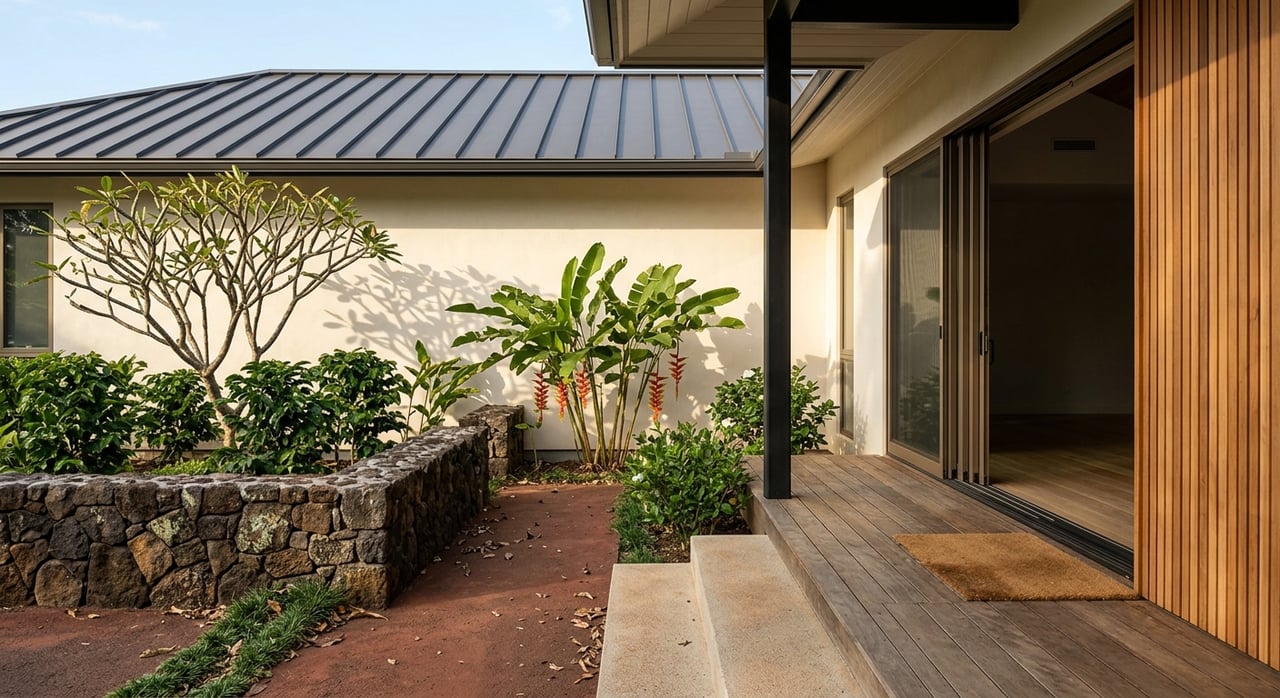
Because of Holualoa’s location and land-use framework, homes here are often tied closely to the land itself. Buyers may come across hillside custom homes, acreage parcels, coffee-farm properties, and rural residences where lot size and permitted uses matter just as much as square footage.
Hawai‘i County regulates land use through state land-use classifications, county zoning, and subdivision code. The county notes that zoning can control permitted uses, setbacks, height limits, parking, density, and other constraints. In agricultural zoning, large minimum lot sizes may apply, and the county’s general plan uses A-5a as an example of a 5-acre minimum lot size.
In some agricultural settings, additional farm dwellings may be allowed if there is a documented farm plan or evidence of ongoing agricultural use, and the dwelling must be tied to farm-related use. That means a property’s potential is not something you should assume based on the lot alone. You need to verify what is allowed for that specific parcel.
This is one reason Holualoa purchases often require more than a standard home search. The land can be a major part of the value, and understanding county rules early can help you avoid costly surprises later.
Many buyers compare Holualoa with coastal Kailua-Kona, and that is a smart place to start. While both areas are part of West Hawai‘i, the daily living experience can feel very different.
Holualoa is shaped more by elevation, hills, and rural land use. Coastal Kailua-Kona offers a different convenience profile, while Holualoa tends to appeal to buyers who want privacy, character, and a stronger connection to coffee-country landscapes.
University sources describe the mountainous Kona coffee belt as a place with natural beauty, thriving commercial agriculture, historical culture, unique architecture, and excellent weather. At the same time, life in the uplands often comes with more driving, steeper lots, and more parcel-specific logistics. That does not make one area better than the other, but it does make the choice highly personal.
If you want a setting that feels more rural and distinct, Holualoa may be a strong fit. If you prefer a denser coastal pattern with different day-to-day convenience, you may want to compare both areas carefully before making a decision.
In Holualoa, due diligence is especially important because the land and infrastructure can affect both livability and long-term cost. A beautiful home on paper may come with slope, drainage, access, or utility issues that deserve a closer look.
County materials describe North and South Kona agricultural lands as steep and rocky, with rainfall patterns between 40 and 70 inches annually. Those conditions help explain why buyers should look closely at details such as driveways, drainage paths, retaining walls, irrigation, and overall slope management.
Two homes in the same general area can perform very differently depending on the lot. One property may have easier access and better drainage, while another may require more maintenance because of grade or runoff. In Holualoa, parcel-level review is not a minor detail. It is a core part of the buying process.
A careful review can help you understand not only the house, but also how the site functions over time. This is especially valuable if you are buying from off-island and cannot evaluate those conditions as easily on your own.
Water and wastewater should be verified early in your search. The North Kona Water System uses groundwater sources that include the Hōlualoa Well, and the county says the source mix can change based on supply and demand.
The system’s source-water assessment also identifies cesspools, septic tanks, roads, and diversified agriculture among the potential contaminating activities. For buyers, that means it is wise to understand not just whether a property has water service, but also how the broader parcel conditions and wastewater setup may affect due diligence.
In Holualoa, sewer service is not uniform across the uplands. Before you write an offer, confirm whether the property is connected to public sewer, served by septic, or still operating with a cesspool.
This matters because the Hawai‘i Department of Health says cesspools discharge untreated wastewater and must be upgraded, converted, or closed by January 1, 2050. The department also warns that if a property’s wastewater system is not compliant, a new homeowner can become responsible for bringing it into compliance.
If a parcel is accessible to sewer, Hawai‘i County says owners generally must connect within 180 days after official notice. That makes wastewater review more than a box to check. It can directly affect your budget and planning.
Volcanic hazard is another topic buyers should address early. Hualālai is an active shield volcano, and the USGS says about 80% of its surface has been covered by lava flows in the past 5,000 years. The last eruption was in 1801.
That does not mean every Holualoa property has the same risk profile. It does mean you should check the official USGS lava-hazard map for the specific parcel instead of making assumptions based on a mailing address or a general area description.
On the Big Island, broad location labels can hide important differences. A parcel’s exact placement can affect hazard context, access, and how you evaluate long-term ownership. In a market like Holualoa, those details are part of making a well-informed decision.
This is where local guidance can make a real difference. When your agent understands upland West Hawai‘i property conditions, you are better positioned to ask the right questions before you commit.
If you are seriously considering Holualoa homes for sale, keep this checklist in mind:
Holualoa is not a plug-and-play market, and that is exactly why many buyers love it. It offers a blend of elevation, privacy, agricultural character, and arts-centered identity that can be hard to find elsewhere in West Hawai‘i.
The key is to buy with a clear understanding of what comes with that lifestyle. When you match the right property to your goals and complete careful due diligence, Holualoa can offer a deeply rewarding way to live on the Big Island.
If you want experienced local guidance as you explore Holualoa, Lailan Bento can help you evaluate the land, the home, and the details that matter most in coffee-country living.

Lailan Bento is the principal broker and co-founder of Hawai’i Development Group, where she is recognized for her integrity, expertise, and dedication to client satisfaction. She began her career in the governor’s office, gaining invaluable experience in Hawai’i laws and regulations, before establishing herself as a respected businesswoman in real estate. Known for her relentless drive and commitment to going above and beyond, Lailan’s love for her island home and community is at the heart of her work, making her a true embodiment of the spirit of Aloha.
📍 75-5915 Walua Rd, Kailua-Kona, HI 96740
📞 (808) 936-1800



Lailan Bento
Lailan Bento | February 20, 2026
Lailan Bento
Lailan Bento | January 26, 2026
What to Upgrade Before You List
Lailan Bento
Lailan Bento | January 25, 2026
Everything You Need to Know Before Purchasing a Luxury Home, Resort Condo, or Investment Property on the Big Island
Lailan Bento
Lailan Bento | October 23, 2025
Hawaii luxury real estate is a segment of the housing market that stands out for its unique features and allure.

Lailan Bento
Lailan Bento | January 15, 2025
Protecting Your Investment: Understanding the Value of a Home Warranty.

Lailan Bento
Lailan Bento | September 23, 2024
The Big Island of Hawaii, with its pristine beaches, exotic landscapes, and vibrant culture.
Lailan Bento
Lailan Bento | September 23, 2024
The real estate market in Hilo is closely affected by the basic principles of supply and demand.
Lailan Bento
Lailan Bento | September 23, 2024
Effective communication is the cornerstone of any successful relationship.
Lailan client’s happiness and satisfaction is the foundation of her success, which shows in her exceptional record of going above and beyond for others, Work with her today!